District 65 Test Results: Long Way to Go
An initial review of this year's test results from the State of IL
Last week, District 65 published their annual IAR report with test scores. You can read at the link below. I’ve included prior year's reports as well.
I don’t like writing about test scores. In elementary education, they’re a moving target. The data is noisy and some of the sample sizes are very small, such that one or two kids can move the numbers. For that reason, I don’t like looking at individual elementary schools. However, looking at the metrics at the middle school or district level, I think is a fair way to ballpark how the District overall is performing.
The results don’t seem great.
First, we can look at overall performance compared to neighboring districts. Below is a list of nearby K-8 districts I’ve isolated based on proximity (North Suburban Cook/Lake County). I’ve excluded CPS, which is not K-8 but their scores are would be at the bottom.1
I realize some of these Districts are wealthier or smaller than District 65, but not all of them are. Either way, we’re close to the bottom.
District 65 Math is Failing Black Families
In 2023, a Northwestern professor polled 400 Black residents of Evanston. In this poll, 79% of respondents felt that a STEAM (Science, Technology, Engineering Arts and Math) should be the curriculum focus.
We are failing these families. Badly.
Forget about the achievement gap or white kids for a minute and look at how performance compares to student achievement in neighboring districts. I’ve excluded districts that did not have a significant sample of Black students. This is from the raw IAR data provided by the state.
The achievement gap persists - at Haven Middle School, for instance, less than 10% of Black students are meeting or exceeding proficiency for math, compared to more than 50% for white students. The achievement gap is not much better at the other middle schools.
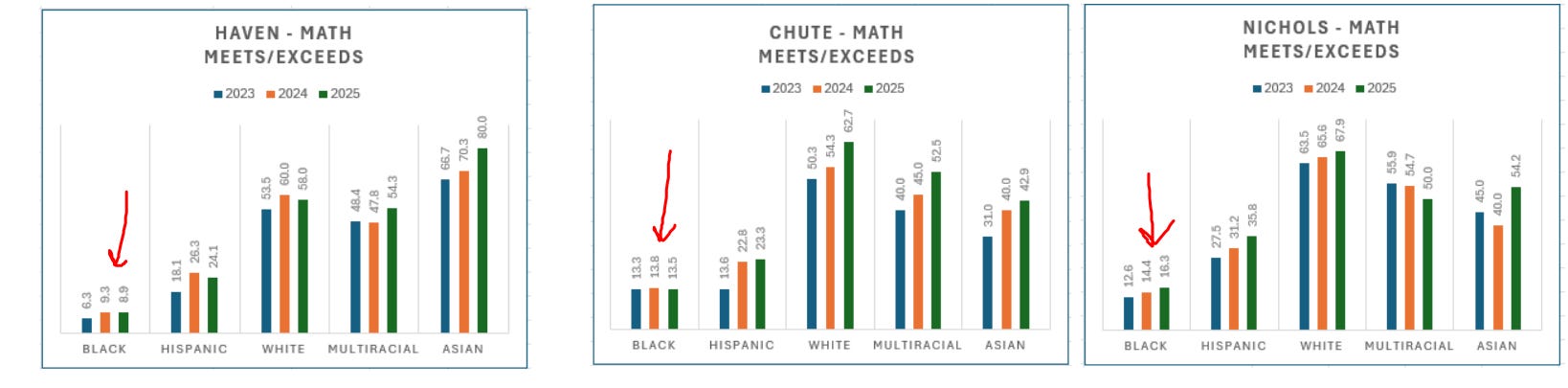
There’s no way you can blur your vision to make these results look like statistical noise. District 65 is objectively failing Black kids at math. The numbers are tragic - according to the IAR report, by middle school, 8/10 black kids in District 65 are not proficient in math.
I don’t know what the issue is here specifically but it seems completely broken. If you have more info on this, throw into the comments.
Language Arts: Reasons for Optimism?
The language arts situation is also bad, but there are perhaps some reasons for optimism. On the southeast side of Evanston, the percentage of Black students meeting or exceeding proficiency increased from 18% → 30%. Black student achievement at Nichols and all three feeder schools has increased in absolute terms.
But the achievement gap remains at Nichols. There is still a ~50% point gap between white and black kids reaching or meeting proficiency in ELA. For instance, here is the same table as above but for white students, who increased from 63% → 83% over the same period.
Chute has had some success as well. Between 2022 and 2025, the percentage of Black students reaching or exceeding proficiency increased from 22% -> 39%. The absolute numbers at Haven remain low, but have increased in 4 years from 6% (yikes) → 19% meeting or exceeding.
We’re at least moving in the right direction.
In talking to academics, researchers, teachers, and school districts about the achievement gap, I always ask, “Is there a school district anywhere that is an example of closing the achievement gap? If so, how did they do it?” I have yet to get an answer to this question. The education business is full of promises about closing the achievement gap but is sadly, short on district-wide success stories. If you have an example, throw it in the comments.
So that raises the question: the recent increase in Black students meeting or exceeding proficiency - what are the schools doing right? How can District 65 bottle and replicate this success? Getting Chute from 22% -> 39% or Nichols from 23% → 31% seems like something the schools can build on. The Board should drag in the educators and the principals to testify what they’ve been doing that worked .. and do more of it.
But there’s still a long way to go.