District 65's Technology Is Harder to Unwind Than It Looks
The tablets are built into the curriculum itself
At yesterday’s Board meeting, more than a dozen parents turned out during public comment to speak against the district's proposed $551,135 purchase of 1,300 iPads, and almost every one of them was there for the same reason: they want fewer screens in classrooms, not more.
The Screen Sense Evanston petition had 1,128 signatures by meeting time. Miriam Kendall, speaking on behalf of the group, put it bluntly: "We can stop wasting money on iPads just as quickly as we started .. invest in neighborhood schools, teacher salaries, and reading and math specialists instead.”
The iPad vote was deferred to the March 23 board meeting.
Wait, Do I Love Technology?
After I wrote my piece on technology last weekend, I realized a few things:
When I was in graduate school, I was in a program called Reach for the Stars, where I was placed in a high school classroom. During this time, I literally wrote lesson plans using technology to teach kids science.
My entire life depends on technology - I work in the technology business, I write and distribute this blog using technology. It pays the bills and is the reason I can live here. Many of the skills I acquired were from screwing around with technology in schools in the 1990s.
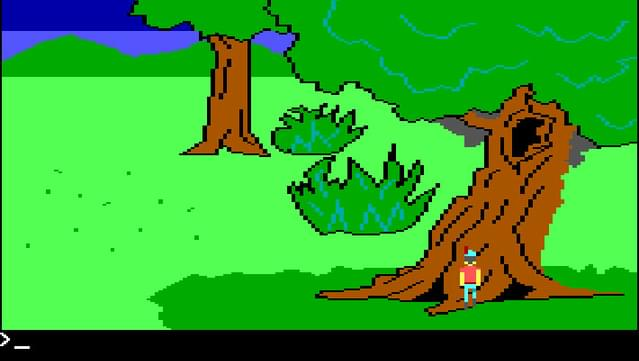
I learned how to read using video games: 1980s Sierra Adventure games: Space Quest II and King’s Quest I (my parents never let me play Leisure Suit Larry)
Given all this, I guess I turned out fine. So maybe I’m the bad guy here. But I think there’s a few reasons to argue that technology in education is fundamentally different now than it was when I was a kid.
Two Modern Visions of Classroom Technology
I’ve been living in the weeds on this topic for a few years. Part of the tension comes from two visions for the role of technology in education, accelerated by the introduction of artificial intelligence since 2022.
Pro-Technology:
The technologist argument is the following:
Technology permits differentiated learning - the same kids can all be working on different lesson plans customized to their individual level.
Technology permits rapid assessment and real-time evaluation.
Assessment using technology can be linked to state standards and power the shift to standards-based grading.
Technology frees up staff to focus and identify the students who need remediation and focus their attention.
Artificial intelligence allows the differentiated learning to be further optimized to the student’s specific learning styles and goals. See Alpha School, opening in Chicago this year.
A good summary of the argument is available in Moeller & Reitzes (2011), a paper which describes a few experimental charter schools such as High Tech High, mentioned in some of the D65 documents.
Anti-Technology:
The opposing argument is the following:
Learning on screens is fundamentally different than traditional learning. It impacts comprehension and attention in ways that are not yet well understood.
The technologist vision above is wishful thinking - despite having all these things in place, including a focus on measurement, we’ve seen no measurable wins.
Given the above two points, this feels like experimentation on our kids.
Students don’t use the technology in the way envisioned without supervision from educators - adding work for teachers, not reducing it.
Commoditizing learning turns educators into glorified exam proctors and wastes their talent.
The profit motive from the technology providers creates incentives to build addictive games, instead of learning.
Artificial intelligence systems are glorified cheating machines and impede student’s ability to develop critical thinking skills.
There’s a growing body of anecdotal evidence coming from higher education indicating that the screens are impeding comprehension - consider the remedial math crisis at UCSD or this study on reading comprehension in Kansas. But there’s a whole slew of confounding factors: grade inflation, weakening standards, and COVID.
Untangling is Going to be a Heavy Lift
My initial thought was, “Okay, who cares about ST Math and the gamified apps, let’s just dump the tablets” — but it’s going to be hard. The technology is deeply integrated into the curriculum itself.
Consider math: i-Ready, made by a company called Curriculum Associates. i-Ready is the primary math curriculum for K-5 students and is three products layered on top of each other.
The first layer is a diagnostic assessment. Several times a year, students take an adaptive test. The test adjusts the difficulty of each question based on the last answer — and the software produces a detailed report placing each student on a learning scale. That scale runs continuously from kindergarten through eighth grade, and it tells teachers exactly which skills each student has mastered and which they haven't. A January/February 2024 curriculum review explains the choice (IAR is the state proficiency scoring system)
"The i-Ready Diagnostic is strongly predictive of IAR attainment, due to its strong alignment with the expectations of the standards, and its reports provide accurate and actionable information to educators working with students both below and at grade level."
As a parent, I’ve found this diagnostic score genuinely helpful and in the era of the standards-based report card - it’s now the primary signal I get regarding performance.
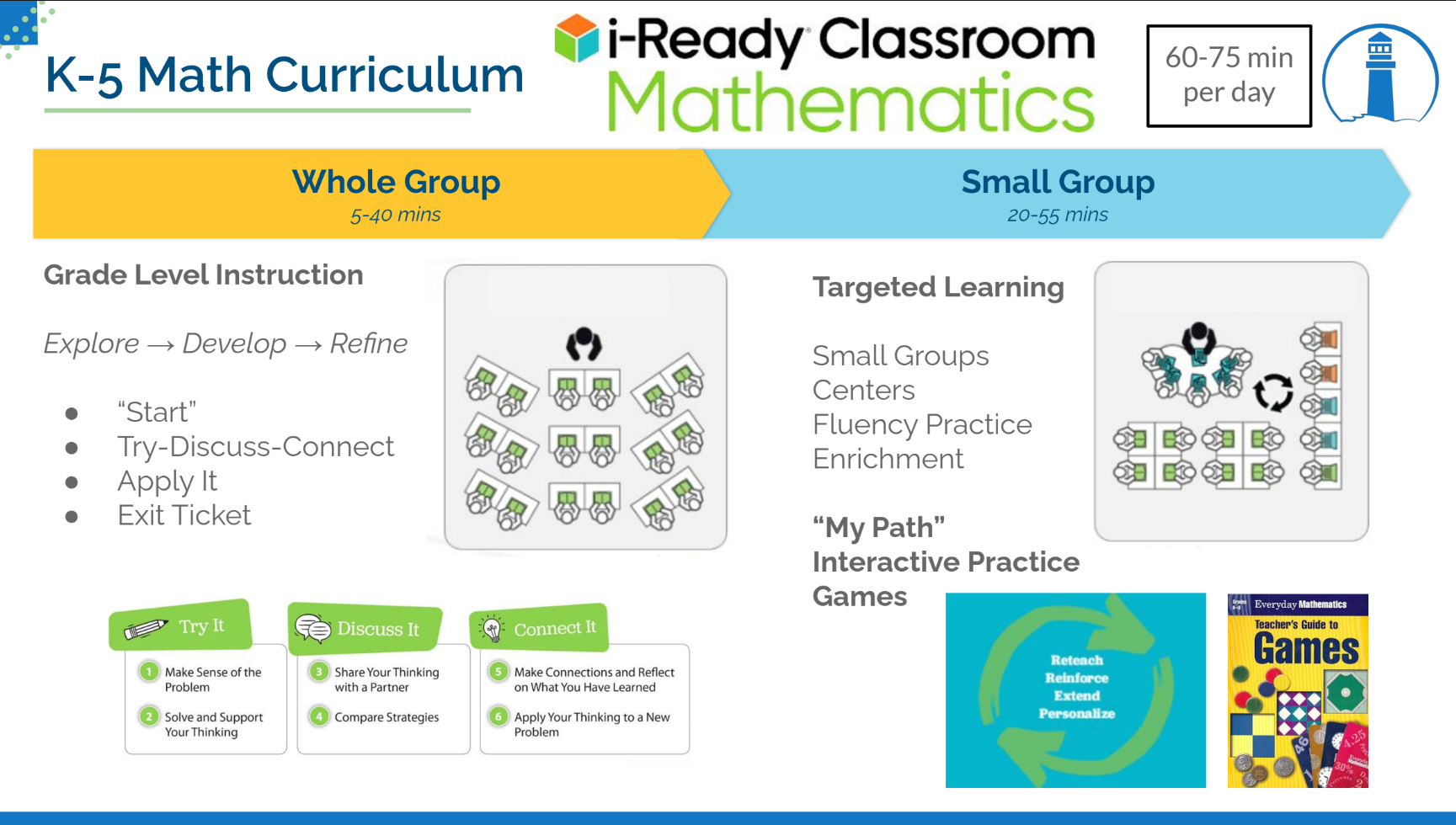
The second layer is i-Ready Classroom Mathematics, the K-5 math curriculum itself. This isn't supplemental material — it is the lesson plan. According to the December 2024 math presentation, the K-5 math block runs 60 to 75 minutes per day and follows a prescribed structure built around i-Ready's framework. The whole-group lesson phase uses i-Ready's "Try It / Discuss It / Connect It" format — a specific pedagogical sequence the company has designed and branded. The December 2022 Curriculum & Policy presentation marks when this became official: "i-Ready Classroom Mathematics: Adopted SY23."
The third layer is MyPath, i-Ready's personalized practice engine. After the diagnostic places a student on the learning scale, MyPath generates a queue of on-device “interactive practice games.” This is what kids are doing on iPads during the small-group and independent work portions of the math block. It's also what fills middle school WIN time. The December 2024 presentation shows explicitly how this works:
These three layers aren't separable. The diagnostic feeds the curriculum. The curriculum generates data. MyPath uses that data to personalize the practice. You can't cancel one layer without disrupting the others. If you throw the tablets in the trash tomorrow, you will need to figure out how to rebuild systems like assessment, grading, schedules, and retrain staff.
Where do we go from here?
I first knew that D65 had a serious screen management back in 2022. I picked up my kid from after care and all the kids were on their tablets. One kid had figured out a way to use the coding app on the tablets, Scratch, to watch unfiltered YouTube (this was before D65 banned YouTube outright). From a technical standpoint, that was insanely impressive - a YouTube client in Scratch!? But from an IT/Systems management standpoint, yikes.
I signed the Screen Sense petition because I think they have the most compelling arguments right now. To me:
The i-Ready/tablet approach feels more like automation than education. The whole idea of education as delivering standardized units-of-learning to be optimized feels icky, commoditizing, and isn’t even working.
The 1:1 roll out has not been managed well. If kids are getting around the security to play games instead of using the learning apps (which almost every parent has observed in some form) — you have a real problem. It got so bad that in September 2025, the administrators removed almost 300 apps from the tablets and adjusted grade levels.
All of this is costs money we don’t have. We’re closing schools and ending summer camps while at the same time purchasing new equipment and new curriculum seems like misplaced priorities (that prior boards never bothered to critically discuss)
Evidence is building that screens-in-education are having negative outcomes. There’s a growing body of evidence that technology is impeding comprehension skills. Anecdotally, high schools and colleges are complaining about this. Miriam Kendall, in her comment, pointed out that local private schools are successfully advertising that they’re not using screens.
In a way, it boils down to the same trust issue that District 65 has been dealing with for years now — parents want education to come from teachers, not administrators or ed tech companies. As the world around us is increasingly commoditized and optimized, it feels like nothing is sacred anymore and we’re not even seeing the upside.