And an exploration of a crazy piece of state legislation, the Affordable Housing Omnibus Bill.
Tom HaydenOctober 23, 20258 min read
Update 11/5/2025: This story contains some errors regarding the tax calculations. There is a follow up story in the works.
The hottest topic in town right now is a property development in downtown Evanston at 605 Davis. There have been innumerable op-eds written to the Evanston RoundTable about the project.
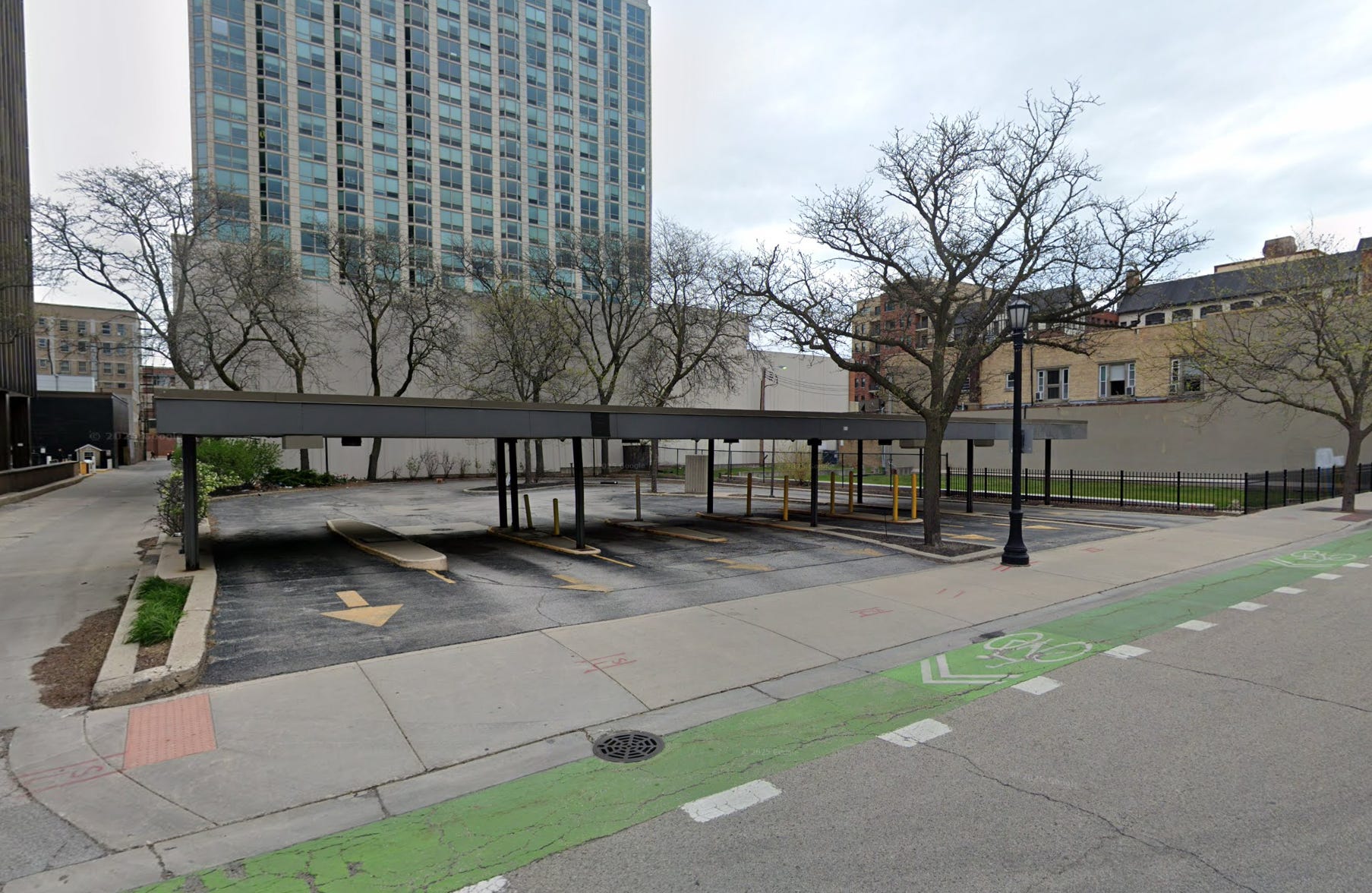
First, let’s discuss the lot in question. It’s the abandoned Bank of America lot across the street from my former favorite Chinese restaurant, RIP Peppercorns Kitchen. Anyway, here’s a photo of the lot:
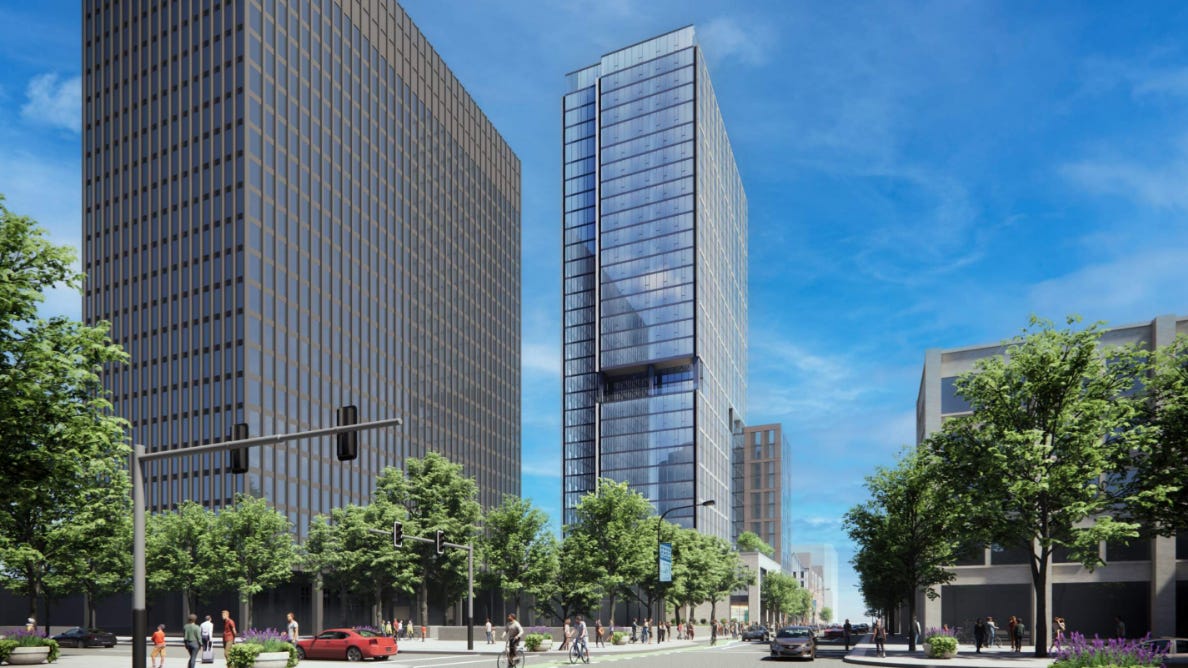
The project is a 31-story mixed-use residential high-rise developed by Vermilion Development and Campbell Coyle. It will include 430 residential units—20% of which are designated “affordable”, along with ground-floor commercial space.
State Law: HB 2621
Let’s talk about this piece of legislation from 2021: the Affordable Housing Omnibus Bill. When I first heard about this, I didn’t believe what people were telling me because it’s a genuinely wild piece of legislation. I still have a hard time believing this is real.
It works like this:
Developer wants to build luxury rental apartments;
Rent 20% of the units to households earning 60 percent of area median income (AMI) or less (this is what makes it “affordable housing”), which for 2024 are;
1 person = < $49,800 / year
2 people = < $56,880 / year
3 people = < $64,020 per year
🚨 Get a 100% property tax break (then 80% → 60% → so on) 🚨
In the first 3 years, the developer pays no taxes on the improved lot. Just the current unimproved lot taxes. After that it’s a sliding scale for 30 years, you can see it in my analysis.1
The intent of the legislation, I think, is to align incentives:
Developers: Return value to shareholders.
The State of Illinois: Provide subsidized housing and have someone else pay for it.
Local Politicians: Show people you care about housing prices.
Sounds good, I guess. What’s the problem?
Someone has to pay for this tax abatement. You have two options:
Keep everyone else’s taxes the same: They can leave all other taxes the same but the problem is in Illinois, your local school district gets 70-80% of its funding from local property taxes and they’d be shorted here. This means that the schools would subsidize the project.
Raise everyone’s taxes: The County Assessor can simply take the discount here, add it to the tax levy and spread it out among all taxpayers.
Everyone I spoke with is actually a little unclear on this, but it seems like the consensus is that option #2 above is how it will work. All Evanston taxes will go up to subsidize this project’s tax discount.2
Over the life of the project (30 years), I calculate the tax discount to the developer:
$39,774,808 total tax abatement across all districts, including the Schools, City, County, Library, Mosquito Abatement
If you are a supporter of the building, you’re reading this and saying “Tom, you’re stupid, the lot is currently an abandoned lot full of rats and we don’t do this, then nothing gets built here. This is better than the status quo, and over time, they will pay taxes.”
But for 30 years, everyone else’s taxes will go up! Taxpayers pay nothing for this empty lot now, but in a few years this building’s taxes add onto on your bill.
We could be taken for a ride here and there’s a some evidence to support.
Mayoral Interference
In May 2024, the current owner of the lot (JP Morgan Chase) tried to sell the lot. At that time, the Mayor of Evanston wrote an unusual letter to the land owner, strongly urging them not to sell the land.
Dear Curtis:
I am aware of Chase’s efforts to sell 615 Davis Street in downtown Evanston. For many years, the City has collaborated with Chase, Vermilion Development, and Martha Koch (the adjacent land owner) to encourage redevelopment of this highly underutilized property in the center of downtown Evanston. We were surely all disappointed when the office development proposed for the property succumbed to market conditions related to the pandemic.
We are discouraged to hear that Chase is considering selling its parcel separate from the planned larger assemblage. Without the assembled parcels, it will be very difficult for the City to achieve our affordable housing goals, which in large part rely on new, partially market-rate multi-family projects to create affordable housing. Today, we require developers of new multi-family housing to offer 10% of units to low- and moderate-income households. Because of precedents for height in the downtown area, assembling the Chase parcel with the adjacent parcel to the east maximizes the number of affordable housing units.
Additionally, as we seek a full recovery of our downtown business district from the effects of the COVID pandemic, we are eager to increase residential density as a replacement for lost office workers. I see this as necessary to achieve the economic vitality our residents expect; moreover, increased residential density near mass transit is a key step to achieving our sustainability goals.
I ask Chase to ensure its disposition process incorporates the City’s priorities. We are committed to realizing our strategic goals, which I doubt is possible unless the sites are assembled together for development.
Sincerely,
Daniel Biss
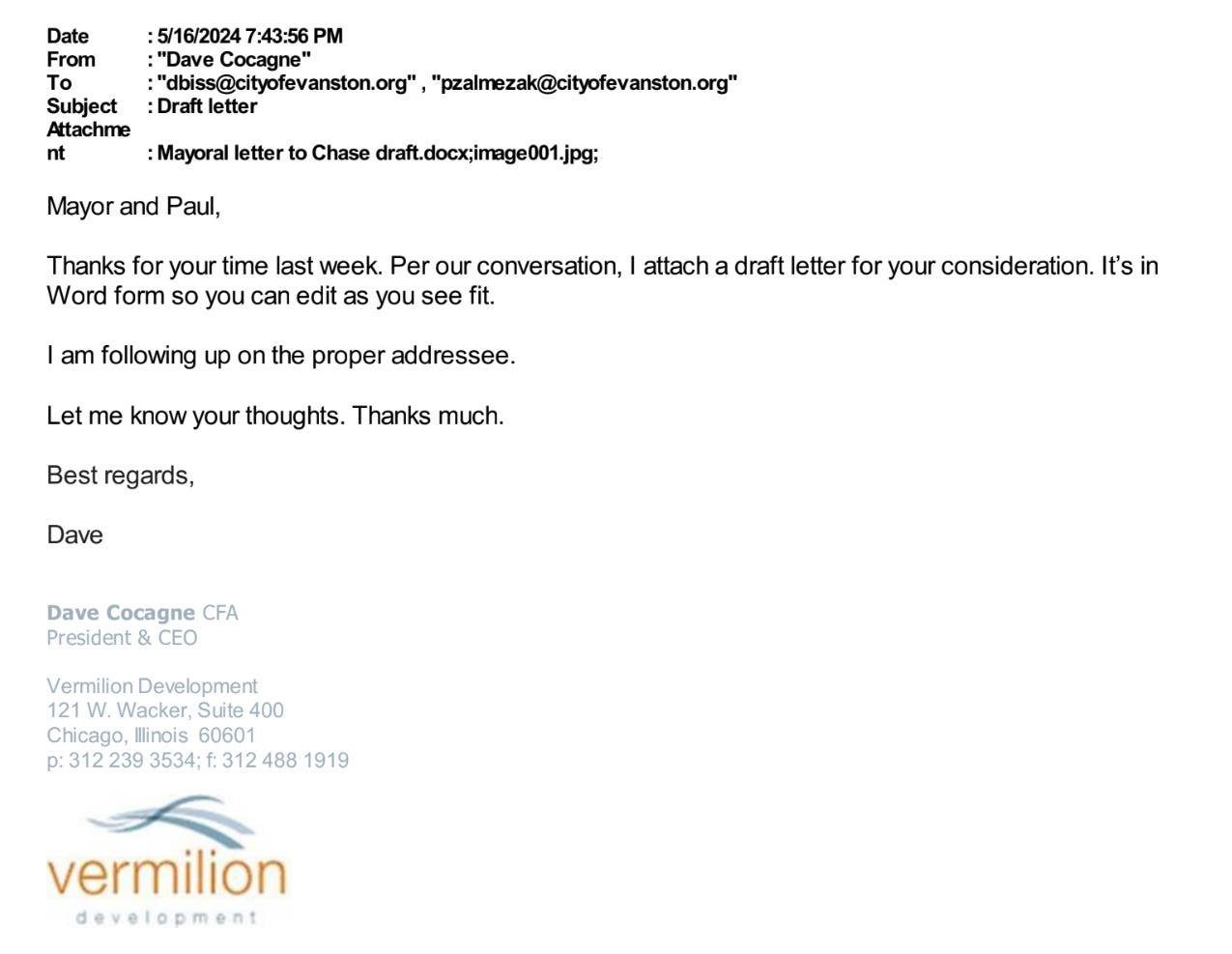
You can read some of the other documentation associated with the letter obtained via FOIA. In fact, the letter itself seems to have been initially authored by Vermilion’s President and CEO.
In the FOIA, you can see the notes where the Mayor juices up Vermilion’s language before sending it out.
I reached out to the City for comment on the letter. They provided me with the following;
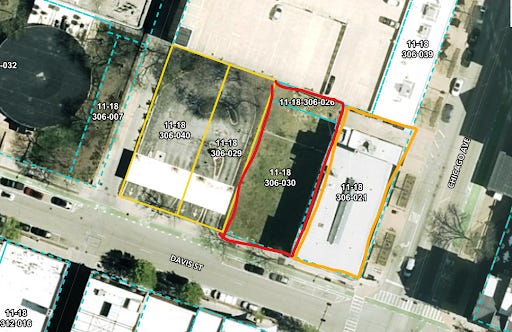
Chase owns the two yellow parcels, while Martha Koch owns the red and orange ones. (see the image for reference)
Before COVID, Koch and Vermillion were under contract to collaborate with Chase on all four parcels but faced two unsuccessful projects: a residential proposal and an office proposal, which failed during the pandemic.
After receiving approval to list the properties for sale, Chase hired JLL to manage the process. Vermillion and Koch submitted a bid and requested a letter of support from the Mayor. Although the Mayor did not endorse a specific proposal, he emphasized the need for residential density and increased foot traffic in downtown Evanston.
Combining all four parcels would better align with the City Council’s economic development and affordable housing goals compared to smaller, separate projects.
Let me know what you think about the letter in the comments.
Exclusionary Housing
Before you accuse me of being a grumpy NIMBY who hates development - I’m 42 and I’ve lived in shared wall apartments/condos my entire adult life. And given the cost of housing, I will probably die in a shared wall apartments/condos. I’m in favor of most ideas supported by the YIMBY crew: separated bike lanes, removal of parking requirements, up-zoning, duplexes, high-rises, and subsidized housing for our most at-risk people. I am generally fine with almost every development.
But this is a hustle.
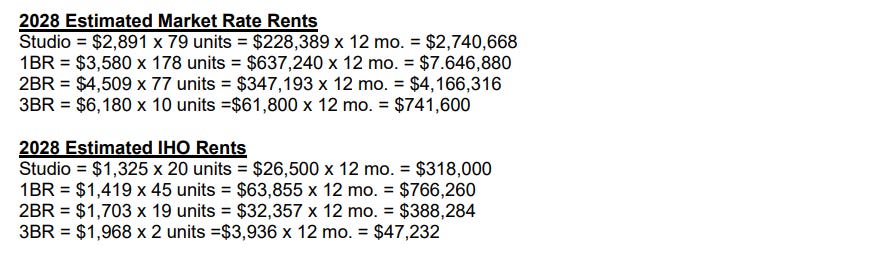
This building is exclusionary to most residents. I have a family of three and I make more than $64,020, so I don’t qualify for affordable housing. But I also don’t make enough money to afford a $4,509/month two bedroom apartment. You can view the rents in the documents, which are exorbitant.
605 Davis Estimated Rents
Even a $1,703/month rent for an “affordable” 2 bedroom is a pretty extreme for someone making less than $64k. It’s not clear to me how they’d even fill those units without additional subsidies. You’d be deeply “house poor” at that level ($1700 rent on $50k income is 40% of your monthly income!). 3
The rents in this building drive up the comps for the rest of us. We’re already looking at increases year-over-year, and having a neighboring building at this level will only empower landlords, increasingly owned by private equity firms.
Everybody in town will be subsidizing taxes for all units in this building, further increasing the cost of living. If there is a District 65 referendum, we all eat the tax increase but the owners of this building won’t.
I get it, the argument in favor of the building is something like: the construction of this building will bring in ~600 residents which will spur all sorts of exciting and new activity in the area. It could help local businesses (RIP Peppercorns and Edzos) and the flurry of activity alone will benefit everyone. But do you to pay $100+ in taxes to a developer in order to accomplish this? Do you even need to?
This project is only going to accelerate the existing housing crisis by increasing taxes for the rest of us, while not providing genuinely affordable housing.
So if you’re building luxury apartment rentals: stack a bunch of “affordable” units on the lower floors. This makes the building taller, increasing the value of the higher floors. Then you get the sweet tax reductions for 30 years. Then, after 30 years, you sell the building off as condos.
I think there are a lot of technical details here that are not super clear. My understanding is that they would complete the building and the total taxes would, in theory, go into the tax levy (numerator). But the building owners EAV (the denominator) would stay super low. So the schools would, in theory, get the money from the project .. but this depends on a lot of things working properly, including the Cook County Assessor.
It’s not clear to me who would live in these units. It seems most likely that it would be folks on fixed incomes but with cash reserves - Northwestern students and empty-nesters.